
≡ Menu

Immigration, Slavery and Danny Glover

Ignoring slavery in Venezuela
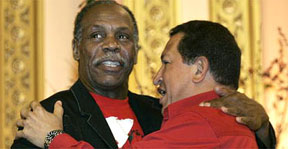
chavezgloverVenezuelan big mouth hugo chavez says he will give the race warlord Danny Glover $18-million dollars to finance a move.  The topic?  Slavery, of course.  From The Guardian Unlimited:

Venezuela is to give the American actor Danny Glover almost $18m (£9m) to make a film about a slave uprising in Haiti, with President Hugo Chávez hoping the historical epic will sprinkle Hollywood stardust on his effort to mobilise world public opinion against imperialism and western oppression.

The Venezuelan congress said it would use the proceeds from a recent bond sale with Argentina to finance Glover’s biopic of Toussaint Louverture, an iconic figure in the Caribbean who led an 18th-century revolt in Haiti.

Mr. chavez should stop worrying about Hari 200 years ago and pay more attention to his own country.  Here’s what the U.S. State Department had to say about Venezuela and slavery only last year.

Venezuela is a source, transit, and destination country for women and children trafficked for the purposes of sexual exploitation and forced labor. Women and children from Colombia, China, Peru, Ecuador, and the Dominican Republic are trafficked to and through Venezuela and subjected to commercial sexual exploitation or forced labor. Venezuelans are trafficked internally and to Western Europe, particularly Spain and the Netherlands, and countries in the region such as Mexico, Aruba, and the Dominican Republic for commercial sexual exploitation. Venezuela is a transit country for illegal migrants from other countries in the region – particularly Peru and Colombia – and for Asian nationals; some are believed to be trafficking victims.


The Government of Venezuela does not fully comply with the minimum standards for the elimination of trafficking and is not making significant efforts to do so. The government made some clear improvements in anti-trafficking activities during the reporting period, such as training officials and undertaking initiatives to raise public awareness. Unfortunately, these increased activities were not matched by progress in prosecutions of traffickers. The government should increase investigation and prosecution efforts against traffickers, continue educating the public, and provide victim assistance geared to the specific needs of trafficking victims.

Prosecution
The Government of Venezuela improved efforts to apprehend suspected traffickers throughout the year; however, there were no reports of prosecutions or convictions of traffickers for the fourth consecutive year. Article 16 of the Organic Law Against Organized Crime, passed in September 2005, makes trans-border trafficking punishable with imprisonment for 10 to 18 years. Provisions of the 2004 Naturalization and Immigration Law could also be applied against transnational trafficking. These recent anti-trafficking laws do not address trafficking within the country. The Child Protection Act and various articles of the penal code could be used to prosecute internal trafficking, but many of these statutes carry low penalties. Laws against child trafficking provide for fines of one to 10 months’ salary. Stipulated punishment for the prostitution or corruption of minors is as little as three months in jail; repeat offenders may face three to 18 months’ imprisonment. In addition, laws against trafficking-related crimes generally were not enforced and some officials failed to distinguish the difference between traffickers and migrant smugglers. Authorities investigated a number of cases of transnational crime, but only four cases were clear instances of trafficking for labor or sexual exploitation. Six suspects awaited prosecution for cases initiated in the current and previous reporting periods. There were no reports that government officials participated in or condoned human trafficking, but corruption among immigration, identification, customs, and border patrol officials was widespread and may have contributed to the small number of trafficking cases reported.

Protection
Venezuelan government services to assist trafficking victims remained inadequate during the reporting period. The government funded no NGO programs and operated no shelters designated specifically for trafficking victims. There were no witness protection or restitution programs to assist victims. Government shelters for battered women and at-risk children had limited space and inadequate services to meet trafficking victim needs. Government authorities did, however, negotiate the use of a government-owned building for an NGO working with trafficking victims. A domestic violence hotline operated by the National Institute for Women reportedly helped one trafficking victim seek assistance.

Prevention
The government significantly increased efforts to raise awareness and train officials as the reporting period progressed. In December 2005, the government launched a national campaign to educate the public about the dangers of trafficking using posters and radio and television spots. The government also increased public awareness about trafficking by hosting a hemispheric meeting on trafficking and encouraging in-depth media coverage of the event both in Venezuela and throughout the region. The Ministry of Interior and Justice’s Crime Prevention Unit held 65 training sessions on identifying trafficking and illegal migration that reached 1,544 government officials in eight states. National toll-free crime line personnel received training for handling trafficking-related calls.

Additionally, UNICEF estimates that almost 10% of Venezulan children were working in 2000.  That does not include the children involved in begging, prostitution or drug trafficking.  The U.S. Department of Labor has issued a full report on child labor in chavez’s country.

The State Department addressed the human rights situation in Venezuela in 2005.

Politicization of the judiciary, restrictions on the media, and harassment of the political opposition continued to characterize the human rights situation during the year. The government used the justice system selectively against the political opposition and implementation of a 2004 media law threatened to limit press freedom. The following human rights problems were reported:

  • unlawful killings of criminal suspects
  • torture and abuse of detainees
  • harsh prison conditions including violence and severe overcrowding
  • arbitrary arrests and detentions
  • corrupt, inefficient, and highly politicized judicial system characterized by trial delays, impunity, and violations of due process
  • dismissal or forced retirements of judges for political reasons
  • unlawful taking of private property, including failure to make property restitution in such cases
  • illegal wiretapping and searches of private homes and businesses
  • official intimidation and attacks on the independent media, the political opposition, labor unions, courts, the Catholic Church, missionary groups, and human rights groups
  • widespread corruption at all levels of government
  • violence and discrimination against women, abuse of children, discrimination against persons with disabilities, and inadequate protection of the rights of indigenous people
  • trafficking in persons
  • restrictions on the right of association

Danny Glover, why aren’t you making a movie about slavery in Venezuela today?

Update – Fausta has observations, too.



{ 0 comments }

Immigration Reform

Did he read the bill?

MartinezFlorida’s junior senator Mel Martinez has announced his support for the immigration reform bill currently before the Congress.  Supporters have said that once we read the bill and understand it, we will favor it .  Hugh Hewitt has read the bill and finds a lot at fault.  Here’s my question sent by email to Senator Martinez:

You say that you are in favor of the Immigration reform bill currently being debated in Congress.

How much time have you spent reading, studying and analyzing the actual bill as introduced?

As always, we’ll let you know if an answer is received.

(No, I have not written Florida’s Democrat Senator Bill Nelson.  I think that’s hopeless.)


{ 0 comments }

Florida Primary

Florida Flag

Moving up

Florida will move its primary to January 29th – the same day as the South Carolina primary and ahead of other big states, such as New York and California.  The parties show that they, as usual, have their heads up their asses by threatening to punish Florida voters.  From MSNBC

Meanwhile, the Republican National Committee has threatened to take away half of Florida’s delegates if the primary is held before Feb. 5. The Democratic National Committee said the state would lose 50 percent of its delegates and all its superdelegates. The DNC also said it would penalize candidates who campaign in Florida for a primary earlier than Feb. 5 by making them ineligible for receiving any of the state’s delegates.

What don’t the politicians remember from 1968?  It was that year that the Democrats decided to throw out the legally elected delegates from Southern states, including my then home state of Georgia.  The delegates were replaced by delegates considerably more liberal than the population at large. Georgia’s delegation, for instance, was led by Julian Bond.  The result was that the Democratic party was severely damaged in the state.  We’ve written about this before.


{ 0 comments }

A day of infamy

An anniversary of murder

It was 23-years ago today that Islamic terrorists made their most successful assault on the U.S. military. On October 23, 1983 a suicide bomber drove a truck into the barracks of the United States Marine Corps in Beirut, Lebanon, and set off a huge bomb. More than 300 Marines, sailors and French soldiers died. The bomber was a member of, and supported by, Hezbollah – the same terrorist organization that fired hundreds of rockets into the villages and towns of Israel in the early summer this year.

Most of the Marines and sailors who died were stationed at Camp Lejeune, North Carolina. They are honored and remembered with a memorial aboard the base.


The American and French and Italian troops were in Beirut as part of a peacekeeping mission. The response to the murders was to run away – and in case you don’t remember who was president then, it was Ronald Reagan. So turning tail and running in the Middle East is not solely a liberal Democrat problem. And if you think running is the answer, I’d love to know how you think leaving Beirut helped world peace.

{ 0 comments }

Bots take over the world

Internet poker, Big Brother, chess and bots

Big Brother Strikes Again

Now that the United States government has shut down on-line poker – in their noble effort to guard morality by preventing innocent Americans from gambling away their government-sponsored lottery winnings – I am thoroughly confused. Why, I wonder, is gambling by playing poker, which at least involves a degree of skill and provides one with decent odds, wrong, while taking a one-in-million blind shot on a lottery jackpot with astronomical odds against you okay? Could it have anything to do with the fact that the government controls all the revenue from lotteries while private businesses control on-line poker? Or, perhaps, the United States government – when not busy running TV ads in a attempt to entice the multitudes to take a chance on a ‘ghetto pension,’ (you think I’m kidding? Just look who’s in the line at the lottery register at the Seven Eleven next time you buy gas) — is just concerned about the morality of gambling? Okay, you can quit laughing now. We all know they’re not-so-pious hypocrites and that there is nothing the least bit moral about our elected representatives. That’s something every American can agree on. But surely, with all the on-line poker revenue out there, suitable bribes (perhaps in the guise of campaign contributions or devastating taxation, which can be channeled back to them) will eventually make their way to congressional pockets and I will be able to wile away the hours trying to get that 11 to 1 inside straight draw on the river.

First They Changed It

Meanwhile, all I have left to play on my computer is Internet chess.

The site I like best is Yahoo Chess. I can sit for hours and chat and play with people in Australia, Germany, Russia, or wherever, in real time. I still haven’t gotten over the neatness of that. And I love it when I win and someone accuses me of cheating at chess or makes a summary judgment about the marital status of my parents and the circumstances surrounding my birth – or when I lose and they gloat and do the Internet version of a victory dance, telling me what a worthless loser I am. Chess, particularly the speed version I like to play, is action-filled, bloody, and frequently filled with nasty invective. Poker, by comparison, is like a Sunday school class.

But recently, the ruling elite at Yahoo, the best chess site on the web, made a disastrous decision (A “Disastrous decision”, according to Webster’s Seventh New Collegiate Dictionary, is a decision that is most likely to be either the product of a committee, a new management team, or possibly a new CEO who formerly worked for MTV): they decided that the best site for on-line chess on the web needed improving.

Heedless of the axiom “Don’t fix it if it ain’t broke!” they proceeded to remake Yahoo Chess. The improvements were, they assured us, in response to a survey of consumer desires.

Apparently, this was in response to demographic surreys conducted among six to eleven-year males with severe Attention Deficit Disorder, since the “improvements” consist of things like the sound of an explosion when you take an opponent’s piece and a flashing neon sign in the middle of the board saying “CHECK!” “CHECK!” “CHECK!” when you check your opponent’s king. (Tell me, if you don’t know when you are in check, what the hell are you doing on a chess site?) Everything about the All-New Yahoo Chess sucked a big one, but the explosions and the flashes on the board were the worse. Chess, even when bratty kids, or mean old coots like me, play it, is a little more cerebral than that.

Quickly, this proved to be a marketing decision equivalent to the introduction of New Coke. Naturally, after a couple of months of protest, Yahoo, like Coke, yielded to popular pressure and brought back the original product, Yahoo chess, now calling it, ah-hem, ‘standard’ Yahoo Chess. There are a few more hoops you have to jump through to get to the actual chess site (a ‘Click here to continue to Yahoo Standard Chess’ page that you pause on long enough for an advertisement to load, and obstacles once you do – ads can suddenly run at the top of the chess board, breaking concentration a bit) but, otherwise, it’s the regular Yahoo Chess.

And Then The Bots Came

What are bots? Bots are computer programs designed to entice boys and men to porn web sites by pretending to be girls chatting on line. They are automated programs with the barest semblance to thinking beings. Think of them as digital blondes. However, being designed to appeal to the libidos of young sexually hyper-active males, they don’t need much intelligence, do they? And like real blondes, they’re not even virtually intelligent. Not that it matters: If memory serves, it doesn’t take much to stimulate the sexual imagination of a young male.

Bots always have screen names like: A sexy girl; a sweet girl; a passionate girl, and say things like:

“Hi. I’m twenty. How old are you?”

“My boyfriend left me!”

“Would you teach me how to play?”

“My cat is walking across my keyboard.” (My personal favorite).

And the kicker:

“I have some neat new pictures on my web site.”

Once upon a time, bots were a rarity. In a central chess chat site you’d come across one now and then, and they were pretty much ignored by the veteran players; however, you would occasionally get some newbie who would, to the amusement of many, try to engage a bot in conversation. (Not really so stupid I guess: every one of you who as a youth made love to a Playboy foldout raise your hands now.) The newbie would be exchanging vital stats (such as A & L) and witticisms with the bot until some avuncular soul such as myself gently clued them in;

Mahone: “Hey, dude, what are you? An idiot? That’s a bot you’re trying to knock boots with.”

Newbie: “A what?”

Mahone: “A bot.”

Then you explain that his lust has been stimulated by a very simple program generating useless drivel, which info, more than likely, causes him to shrivel.

But then, all the porn sites saw that the bots were a good thing. Now, on a Yahoo Chess chat site, there is usually nobody chatting – only various bots, each uttering their inanities in an attempt to lure males to their respective porn sites. They’ve run everyone off the chat site; a pond so full of lures that the fish have fled. Now, the Yahoo chat rooms are usually empty, like a virtual ghost town. Like tumble weeds, the bots are the only semblance of life. It’s eerily like a Twilight Zone episode, one of those where all the people are gone but the machines go on ad infinitum, mindlessly performing their assigned tasks as if everything were normal. Each bot speaks its meaningless drivel in turn, but they exist in a virtual vacuum, where no one hears them.

And thus it will remain until Yahoo’s Central Committee comes up with a bot-killer program, which I suppose would work something like this:

A Cute Girl: “Hello, I’m twenty and I love to pose for . . . ARRRRGGGGGG!”

Maybe they could have explosions and flashing lights on the chat site every time they offed a bot? That would save the chat rooms and keep the MTV generation interested.

Well, since I can’t play poker, and I’m a little tired of chess for today, what can I do? What? Your cat is walking across your keyboard? Your boyfriend has left you and you have some fascinating new pictures? . . . Hold on a minute. Where is the location of your web site again?

{ 0 comments }