Should the parties accept the activists and reject the centrists?
Hugh Hewitt asks for comments on a paragraph from a Jonathan Rauch piece in Atlantic (subscription required.)
“On balance it is probably healthier if religious conservatives are inside the political system than if they operate as insurgents and provocateurs on the outside. Better they should write anti-abortion planks into the Republican platform than bomb abortion clinics. The same is true of the left. The clashes over civil rights and Vietnam turned into street warfare partly because activists were locked out of their own party establishments and had to fight, literally, to be heard. When Michael Moore receives a hero’s welcome at the Democratic National Convention, we moderates grumble; but if the parties engage fierce activists while marginalizing tame centrists, that is probably better for the social peace than the other way around.”
I think Rauch makes several errors in his analysis, and that marginalizing the centrists is a big mistake. I base my views on my personal observation of politics.
 Everyone remembers the Democratic National Convention in Chicago in 1968 for the riots in the streets and the counterattacks by the police outside, as well as the anti-war protests and Senator Abraham Ribicoff’s lecture of Daly inside. But I remember the convention for something else – the marginalization of the centrists from the Democratic Party.
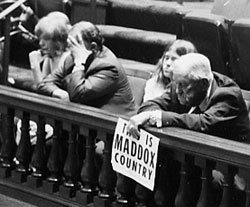
I grew up in Georgia. There were few Republicans, even though Barry Goldwater had carried the state in 1964. There were factions within the Democratic Party – the north Georgia Methodists, the south Georgia Baptists, the Talmadge faction, the anti-Talmadges, and eventually even two urban factions – the Andrew Young faction and the Maynard Jackson faction. The only Georgia Republican I could have named at the time was Bo Callaway, who had run for governor in 1966. (In a very contentious race eventually leading to the governorship of Lester Maddox (I detail here.) The Democratic Party was still a national party.
All of that changed in 1968. The Democrats engaged their left activists and marginalized the tame centrists, and I don’t think they knew they were doing it. Early in the convention, before the riots and demonstrations, the delegates were on the floor handling preliminary matters. The balcony was packed with non-delegates. Suddenly, there was a call for a voice vote to unseat the legally elected delegations from Georgia and other southern states. The network cameras showed the non-delegates in the balconies shouting to remove the Georgia delegation along with the real delegates. The leader of the Georgia delegation tried to attract the attention of the podium to request a roll call vote, as the voice vote was clearly fraudulent. He was not recognized, and the Georgia delegation was escorted from the building.
The Democrats tried to say the state’s official delegation was racist. They substituted a more racially integrated delegation, but one that was far to the left of most Georgians. One co-chairman of the challenge delegation was Julian Bond. It happened just as the old segregationists in the South were losing power to a new generation. The World War Two generation took political power in the sixties, and these people, while not active integrationists, hated the way the segregationists were acting. They looked on with horror when churches were blown up, as black people registering to vote were attacked with dogs and water hoses, and they were voting the supporters of those acts out of office. Just as the Georgia Democrats were becoming more moderate on race, they were accused of being racist, and were kicked out of the party. The majority center-right was removed in favor of a leftist group that was numerically thin.
That was the beginning of the end of the Democratic Party as a national party. Conservative southerners saw they were no longer wanted and began to do the unthinkable. They became Republicans. The once solid Democratic South is now pretty solidly Republican. The Democrats like to say that the racist white people in the south reacted to civil rights reforms and moved to the more racist Republican party. The Democrats blame Richard Nixon, saying he recruited racists into the Republican Party. That’s not what happened at all. The center-right Democrats, who were making lasting changes in race relations in the South, were kicked out of their own party in favor of more leftist Democrats.
That all makes Rauch’s view confusing. Would he have accepted into the Democratic Party the bombers of the church in Birmingham, the police chief who turned the dogs on the demonstrators? After all, these were the extreme activists on the right. What good would that have done?
No, the Democrats marginalized the tame centrists who were able to find a home in the Republican Party – and give the Republicans a national base.
Rauch seems to see the people voting for anti-abortion planks in the Republican platform as the same people who blow up abortion clinics, and that’s where he makes his mistake. The clinic bombers and like the old-time church bombers, people who are on the fringes of society and who do not accept moderation in politics. Rauch’s argument fails here because he’s arguing to include people no sane party would include. The people working for Republican Party platform planks are the same as the former Georgia Democrats – people who have centrist views and who should be welcomed into the party.
On the left, Rauch argues more successfully using Michael Moore as an example. Despite his hateful words, Moore’s done nothing violent that I’m aware of, and could be included as a wacky but acceptable member of the party. The leftist equivalent of the clinic bombers would be something like the Earth Liberation Front, a group that I never expect to see included in the party.
How could there be better social peace of clinic bombers and ELF murderers became the face of the parties?
Update – Mahone Dunbar adds:
His first statement is true all around; it is obviously good to be working inside any system that allows you the privilege to do so. As far as marginalizing “tame centrists”, that will come to an end when the centrists have had enough of marginalization, realize the system has thwarted their political voice, and then move outside the system to become the new radicals, the fomenters of revolution, as it were. This is an age-old historical process.
No matter what the reigning political control system is–left, right, capitalist, communist, anarchists, or anywhere else imaginable on the political spectrum–there will be an element of the population that stands against it. Discontent is inseparable from human nature. It is an inescapable fact that once the dissidents have a successful Revolution, the Revolution then becomes the Institution and is subject to the same principles of dissent as the Institution it overthrew; hence, the order of man’s political nature is Institution, Revolution, Institution, etc. There is no way, short of absolute brutal repression, to stop this process. Therefore, marginalize the centrist and you will simply make them into radicals.
Further Update here.