THE THEFT OF HISTORY
THE QUEST FOR ANCIENT ANTECEDENTS
(Part I is here.)
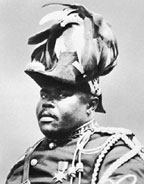 The root of all “Afrocentric” ideas stems from Marcus Garvey (right) – an individual who had no compunctions about bending historical fact for the purpose of creating greater self-esteem in the black community. The deficiencies of black America, Garvey maintained, were the result of a lack of self-esteem; the lack of self-esteem was the result of the lack of great historical achievement, of high civilization, by black African cultures. To remedy this deficit, he had to show that there existed a grand conspiracy by European whites to steal credit from them. The evidence had existed, it had just been obscured or effaced. His basic claims, though not supported by any appreciable evidence, have evolved into a new philosophy of black history. As Asante says, in Kemet, Afrocentricity and Knowledge
 , black historians have finally been freed from “Eurocentric frames of reference.” By “Eurocentric frames of reference,” we presume he means evidence.
It is lamentable that politics and race are mixed indiscriminately with what should be an objective study of history. Afrocentrism is more than a contentious theory to its supporters, it approximates a religious edict that requires ‘faith’ beyond the apparent facts; subsequently, detractors, those who even question the facts, take on the glow of heretics. This is part of the dark side of the Afrocentric myth that makes it more than a harmless detour on the often bumpy road to historic truth. Many at the forefront of Afrocentrism denigrate Europeans/whites and see a conspiracy of aeonic proportions by them to steal credit from black Africa. If the world doesn’t know about Afrocentrism (forget for the moment that no one in Africa over the last thousand years or so felt the need to publish and put forth claims of cultural primo-genesis for themselves) then someone must be responsible for its ignorance; this would be the white man.
* * *
It is hard to establish a ‘fringe’ area of Afrocentric belief, but if anyone walks those tenuous boarders it is Leonard Jeffries. In his model of anthropology the human population is divided into sun and ice people, the former being black Africans and the latter white Europeans; the ice people are by virtue of skin hue, greedy, materialistic, selfish, and violent; the sun people are, again by virtue of their hue, warm and generous, nonviolent (Did anybody tell the Zulus that?), cooperative and spiritual. Black skin also gives one biological superiority to whites as a result of the extra melanin, which, he maintains, regulates health and intellect. As has been pointed out by many, Jeffries’ status as a spiritual, warm and generous ‘sun person’ hasn’t prevented him from issuing hostile diatribes against others, particularly the Jews, and even other ‘sun people’ who disagree with his beliefs. One former student of Jeffries, Fred Rueckher (one of the ‘ice people’), reported that professor Jeffries berated black males in class for succumbing to the “white pussy syndrome” (“Uh, What chapter did you say that subject was in, professor? Are there pictures?”). He also is reported to have called singer Diana Ross an “international whore” because of her fondness for white men. But his most teeth-gritting remark may have been his comments on the disaster of the Challenger space shuttle, which he applauded since it would hinder white people from “spreading their filth throughout the universe.”
For such reasons do vocal opponents of Afrocentrism see it as a dangerous effort by those like Jeffries to substitute their personal wishes for historical reality, and feel that if this continues to occur generations of black youth may be taught a mythic version of reality in which black Africans–the ‘sun people’, warm and generous–are seen as the creators and inventors of everything good while the Europeans–the ‘ice people’, greedy and warlike–are the thieves of history and the originators of all that’s evil.
MORAL STAINS: SLAVERY AND REALITY
If there is one subject which vexes the Afrocentrists, it is slavery. Since it provides the fuel for their wrathful approach to history, they understandably have tunnel-vision on the subject. What they see at the other end of their tunnel is Western culture, which they blame for the institution of slavery and the subsequent degradation it brought to blacks. Afrocentrists never acknowledge the fact that slavery was a universal institution in ancient times since such acknowledgment would lessen the victim status of blacks in America. (The virtual slavery of serfs in places such as Russia and England is quietly ignored, even though the term slave came from the word Slavic.)
Having adopted a position of selective amnesia, Afrocentrists conclude that a culture responsible for an institution as heinous as slavery is morally corrupt, and that all political systems which sprang from it are irredeemable. Blacks, they conclude, should turn elsewhere for political inspiration and moral nurturing. Often they turn to the third world and to Islam, as the former is free from contamination by Western ways and the latter is associated with Africa, and thus perceived as free from the moral stain of slavery. The fact that throwing away Western principles undermines the political platform they speak from doesn’t seem to register with them. The methods of protest blacks have occasioned to use in seeking redress are not African principles – they are solidly Western in origin. But this matters not to the multiculturalists and the Afrocentrists, whose critical faculties seem to be in suspension regarding all subjects related to slavery. Arthur Schlesinger points out: “It is a sad fact that both European and African political traditions approved slavery, as did almost all the traditions we know about. It was the European political culture, however, that first called for the abolition of slavery. Neither racism nor the subjection of women is an Occidental invention, but political antiracism and feminism are.” Though the West was not responsible for the origin of slavery, it was responsible for its decline.
Bernard Lewis, Professor of Near Eastern Studies at Princeton University, agrees with Schlesinger that the West is not responsible for the creation of the institution of slavery; further, he believes that if Western culture is abolished the institution of chattel slavery would certainly return. It is a singular and indisputable fact that, before the development of European civilization, most ancient cultures operated largely on a slave-driven economy, including Greece, where Democratic ideals were born. But it was Western principles and the resulting consciousness they generated that led to the dissolution of slavery not only in Europe and in the New World, but in Asia and Africa. America poet Ralph Waldo Emerson noted that the dissolution of slavery in the New World was the first instance where a revolution was not the result of insurrection of the oppressed, but due to the repentance of the tyrants. The significance of this seems lost to the Afro-centric community.
Since one of the primary goals of Afrocentrism is to vilify European culture, the Afrocentric movement, with little regard for truth, magnifies the shortcomings of European culture and overlooks those of non-European cultures. Arthur Schlesinger calls this “Europhobia” and says that it makes for very bad history. This is evident in Afrocentric writings on slavery, which portray it as the result of a white conspiracy. To do this they disregard the fact that African slaves were captured by other Africans and delivered to Arab slave traders. There are exceptions to this in the black community. An official publication of The Nation of Islam, entitled The Secret Relationship Between Blacks and Jews, asserts that Jewish merchants played a major role in the foundation and running of the black African slave trade. Refutations of such propaganda by historians make no dent in the black community. The leader of the Nation of Islam, Minister Louis Farrakhan, has publicly made disparaging remarks against Jews that have been termed anti-Semitic by even the liberal press.
Though traditional scholars admit that Afrocentric writings contain corruptions of the truth, many tacitly let them pass unhindered. This is because the motive, building self-esteem among black youths, is perceived as justification for the mendacity. To Arthur Schlesinger the ends do not justify the means. Lies, curricula composed of myth and fantasy, cannot help anyone. If they are lying to build self-esteem among black kids, they may pump up their egos for a while, but in the long run, in the real world, believing in fantasies can only hurt them. “If you believe AIDS was concocted by whites in a government laboratory in order to wipe out the black race – as Professor Jeffries is reported to believe – you will be disabled from coming up with a rational strategy to control the disease. If Afrocentric nonsense is intended as medicine for bruised egos, it’s not good medicine. He adds that even trivial falsehoods can work against a person. “Believing that Beethoven and Browning were black is going to make you sound odd to anyone who hears you insist on that as a fact. And when you discover that you have fallen for a series of “therapeutic” absurdities, your self-esteem, which this exercise is supposed to improve, is bound to suffer. The plight of inner-city Americans is indeed appalling, and to fight for themselves they need the best education we can deliver them, not a pack of anodyne lies.”
The well-known adage that ‘those who don’t know history are doomed to repeat it’ applies well to the embracing of third-world political ideas and Islamic religious principles by black-Americans. The God of the Old-Testament not only sanctions the institution of slavery, but gives rules appertaining to it. Many blacks, rightfully, resent this. Though the slaves in question were more-often fellow Semites, the scriptures of the Old Testament, by giving slave owners a sense of divine justification, were used to help keep blacks in bondage in America. But is Islam, which came into being in the late seventh-century and swept like a fire across the continent of Africa, on a higher moral plain when it comes to slavery?
Pulitzer prize-winning historian David Brion Davis thinks not. Writing in The Problem of Slavery in Western Culture (Oxford Paperbacks) Davis points out that “Moslems not only accepted the legitimacy of Negro enslavement, but were inclined to think of black Africans as a docile race who were born to be slaves. The Arabic word for slaves, abid, was increasingly confined to the negro.” Nor were racial relations between the Arabs and blacks any different from the terrible state they were in America prior to the civil rights movement. Davis reports that a virtual race riot occurred in 1498 in Cairo over an interracial marriage between one of the chiefs of the Sultan and a black woman. Few blacks, particularly new devotees of Islam, are aware of the fact that Mohammed, the founder of Islam, owned slaves.
And what of slavery in regards to the one great African civilization of antiquity, Egypt? Here again we have irony based sadly on ignorance. The embrasure of this unique Mediterranean civilization, Egypt, by black Americans is selectively myopic. Historian Davis found it odd that black Americans tried to associate themselves with it, since the Egyptians were actively engaged in the black-African slave trade. In fact, black slaves were far more numerous in Egypt than in the Roman Empire. Therefore, he concludes, the attribution of Egyptian slavery to Greco-Roman ideals is “bizarre.”
Bizarre indeed. Egyptian records relate that the Pharaoh Ramses II, circa 1000 B.C., imported over 100,000 African slaves for use in the Egyptian temples. This is the same pharaoh that protesters demanded be portrayed as black at a Dallas, Texas exhibit of Egyptian culture in 1989 (see Part 1). Yet, in the Portland Baseline Essays, the Bible of Afrocentrism, there is denial that Egyptians had slaves at all. Slavery in sub-Saharan Africa is dismissed offhand, with no mention of its brutality, nor the blood sacrifice black slaves were subjected to by other Africans. There is also the insidious implication that slaves in Africa were somehow better off than slaves in America.
Clearly, Africa and the Arab world bear the most culpability for slavery. Europe and America, certainly not free from the stain of slavery, at least had the moral fortitude to end it among themselves and to help stamp out the pestilence around the world. The fact that Afrocentrists rationalize away the brutality of slavery in Africa, and African complicity in the slave trade, makes perfect sense when one realizes that their agenda involves a hatred of whites. This hatred is fortified by the racist dogma and myth they put out under the guise of history. Their vituperation against the West is misplaced. Justly, it should be directed at mother Africa; not the Africa of Afrocentric myth, but the Africa of reality, the land of brutality, carnage, starvation and tyranny, who sold her children into bondage.
The real Africa, as opposed to the mythic Mother continent of Afrocentric fantasy, is a land beset by problems of almost unimaginable magnitude. According to an assessment by the Carter Center in 1992, though it only contained 14 percent of the world’s population, it was involved with one-third of the world’s armed conflicts. In the last decade of the twentieth century, in spite of Western intervention, millions of Africans have starved to death in the African countries of Ethiopia, Sudan, Somalia, Angola and Mozambique. Africa is rife with disease, particularly AIDS. According to the World Health Organization, over half of the 13 million people in the world who are infected with the AIDS virus are in Africa. AIDS is not the only killer. Africans have the lowest life expectancy (49 years) and the highest infant mortality rate in the world. It also has the highest birthrate in the world. As of 1993 Africa had a population of 670 million, comprising 52 countries. In sub-Saharan Africa black Africans constitute over 800 different ethnic groups; each with its own language, religion and mores. Politically, Africa has a record for tyranny and human rights violations that is nothing short of astounding.
Western intervention is the only thing that saves some African lives. By some estimates Africa contains half of the world’s refugees and half of the world’s AIDS patients. Perhaps the Afrocentric hatred of the West, and white people, is a psychological case of collective projection, something more acceptable than self-hatred? (Projection is a mechanism by which an individual transfers blame to others, finding in them those attributes of himself that are most unacceptable.) Given this, it is no wonder that so-called Afrocentric scholars are unenthusiastic about their followers finding out about the historic realities of slavery.
To reiterate the point: the West did not create the slave-trade. When the Portuguese arrived in Africa in 1480 A.D. they found the slave trade to be well established and thriving. In places like Timbuktu and Songhay, places sighted as ‘high civilizations’ by Afrocentrists, children were bred for slavery. In the medieval period slaves were bred for sacrifice. The term is slave trade, and trade is a two way street. There were sellers in Africa as well as buyers elsewhere. As African scholar Roland Oliver stated in The Cambridge History of Africa 8 volume set (The Cambridge History of Africa) (abridged version A Short History of Africa: Sixth Edition
 ), slavery could not have existed without the cooperation of African tribal states. The slave trade of Alex Haley’s Roots: The Saga of an American Family
 is fiction; the slave economy of Africa was run by Africans, not white despoilers. No black professors were dragged from their classrooms and sold into bondage by whites, as some Afrocentric writers maintain. In the Middle-East various Arab countries had a well established slave trade a thousand years before the European-African slave trade began, in fact, before there was a Europe. And after Europe had divested itself of the practice, after the United States had fought a war involving it, it continued in the Middle East, Africa, and Asia. It was not African chiefs who moved against slavery. Slave markets still existed as recently as the 1950s and was only officially abolished in Saudi Arabia in the 1960s. And there are reports that it still exists in both Africa and parts of the Middle East, with boys selling for the equivalent of $240 and girls for $160.34
As author Robert Hughes succinctly noted in Culture of Complaint: The Fraying of America (Oxford American Lectures) , “If, as H. Rap Brown once observed, violence is as American as apple pie, then slavery would seem to be as African as Yams.”
STOLEN LEGACY
Just Who Is Doing The Stealing Here?
Afrocentrists see conspiracy at every point in history. Even the burning of the Library of Alexandria is attributed to a “white” conspiracy to steal what they claim is black knowledge. The Library is prominent in Afrocentric theories. In G.M. Jame’s 1954 book, Stolen Legacy the author claims that Aristotle, the famed philosopher, and tutor of Alexander the Great, bought manuscripts from the Library of Alexandria with money he earned from Alexander. This was the source of his knowledge, the author purports – though he gives no evidence whatsoever to support this theory. Yosef ben-Jochanan, writing in Africa: Mother of Western Civilization (African-American Heritage Series)
 , goes so far as to declare that Aristotle stole his ideas from Africans (read Egyptians) by sacking the temples and lodges of Egypt upon his arrival in 332 B.C. with Alexander the Great. Such theories are “nuts.” Egyptologist Frank Yurco, of Chicago’s Field Museum of Natural History, is quoted in Schlesinger’s The Disuniting of America: Reflections on a Multicultural Society
 . He goes on to say that with unsupported beliefs such as these, Afrocentric texts are “a melange of misinformation, inconsistence, outright fallacious information, half-truths, and outdated information . . . [and] virtually useless as scholarship.”
Mary Lefkowitz, Professor of the Humanities at Wellesley College, points out that there no factual basis for the claim that Aristotle stole knowledge from Egyptian sources. She also notes that the Library Alexander is accused of sacking was founded long after his death! A slight factual error. Alexander’s deeds are renowned through out the ancient world; to be accused of sacking a library named in honor of himself is odd enough, but to have sacked it before it was created is altogether remarkable. But such is Afrocentrism.
The great Library at Alexandria contained nearly half a million volumes and was the pride of the ancient world. In reality, it was accidently set on fire in 51 B.C. by Julius Caesar’s navy as they sprang a surprise attack on part of the Egyptian fleet in the harbor at Alexandria. Next, in 389 A.D. Christian fanatics, whipped into a frenzy against Paganism by a rabble rouser called Peter the Reader (ironically named because of his illiteracy), attacked and burned the remains of the library, now housed in the Serapeum. Once again some works of the library survived, lying around unharmed until an Islamic wind, under Mohammed, swept into Egypt in 640 A.D. In 641 A.D. the current ruler of Alexandria, Caliph Omar, was asked what should be done with the scrolls. If they disagree with what’s in the Holy Koran, he is reported to have said, then they are evil – and should be destroyed. If however they agreed with the Holy Koran, then they were needless – and should be destroyed. Thus was the residue of the library consigned to flames. The parchments were used as fuel for the baths of Alexandria, of which the Arabs found four-thousand when they took over the city. The library’s scrolls were said to have kept the baths warm for six months.
The destruction of the library occurred over almost seven-hundred years and was the result of uncoordinated efforts involving the Pagans, Christians and Islamics, (An unlikely group of co-conspirators one must admit) who all contributed to the loss of an incalculable part of mankind’s heritage. As if all this isn’t enough, it couldn’t have been an attack against ‘black’ wisdom since the library was started, funded and preserved by Ptolemaic Greeks regents who ruled Egypt from Alexander’s death (circa 300 B.C.) until the Romans took over half way through the first century B.C. Hardly a well planned “white” conspiracy by anybody’s standards, except Mr. Jeffries.
Similar racial and cultural scapegoating has occurred numerous times in history – always with disastrous results. And many black scholars have already begun to note the danger such linear thinking invites. Henry Louis Gates Jr. warns that many are using African-American studies not as a way of rediscovering a lost cultural identity, but of inventing one that never quite existed.
The problem with Afrocentrism is not the valuable role people of African extraction have played in history, but the attempt by ignorant black Americans to purloin the culture of another people – perhaps the most brazen attempt at theft this or any other generation will see.
Since the main arguments for African origin of culture, science, philosophy and art revolves around their association with the Ancient Egyptians, the primary question is “What was the racial makeup of the ancient Egyptians?”
As ludicrous as it seems, some Afrocentrists point to any ancient statue of an Egyptian with thick lips and a broad nose and cite that as proof that the individual was black. This conveniently overlooks the thick lips and broad, flat noses found on Orientals of the near and far East, some indigenous peoples of the American continents, Jews, and even the occasional European. Without seeing the total view in a sculpture, including such distinctive features as the hair of Black-Africans, it is almost impossible to assert that a particular representation in stone is not of a Black-Egyptian. Luckily for us, the ancient Egyptians are not mute on the subject of their race; they left literature and a vast legacy of art, including painted portraits and statuary, which unambiguously clarifies their skin color and race.
The same type of evidence, in part, is used to support the presence of black Africans in the Pre-Columbian Americas. Though this evidence also includes statues with big lips, they may be on safer ground: if there’s not a lot of evidence supporting black colonization of the Americas – at least there aren’t museums full of archaeological detritus that directly contradict it, as in the case for a black Egypt.
Dispersed throughout the jungles along the Eastern Coast of Mexico are a dozen or so mysterious basalt heads, some eight feet high and weighing in at a hefty forty-tons. These, and dozens of perfectly spherical stones, were attributed to the race called the Olmecs (Old Mexicans) – the predecessors of the Mayans, were first discovered by archaeologist Matthew Stirling in 1939 when his team dug the earth away from the awe inspiring and mysterious heads. They are completely unique in terms of other Meso-America works; as well, they are without precedent in any other ancient culture! (Recently, in the Shennongjia Nature Reserve, in China, perfectly spherical table-sized stones have been discovered. Atlantis Rising, May/June 2008) And that is a problem for Afrocentrists who would like to claim them as representations of black Africans who came to the New World in 800 B.C.
The heads have large lips and broad fat noses, suggestive of a type of black face – and equally suggestive of some native American faces, and Polynesian. It has also been noted that they are
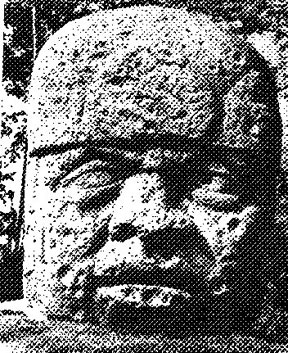
Fig. 1 Olmec head from the East coast of La Venta
prognathic, meaning the lower jaw extends beyond the face. Perhaps this is expected as an engineering must, if not a stylistic innovation, so forty-ton heads won’t roll. Afrocentrists proudly claim the heads are of Africans who made it to the Americas 2000 years before Columbus. But the heads’ uniqueness argues against this. If the heads are of African origin – where are the eight-foot high stone heads in Africa? For that matter, where are two foot high stone heads in Africa, i.e., they are no developmental styles leading to this, nothing remotely comparable to them in Africa or elsewhere. Though it is not impossible that Africans came early to the Americas, the evidence certainly isn’t sufficient to close the books on the subject.
It is also pointed out that Nubian soldiers around 700 B.C. wore helmets similar to those represented on the stone heads. The Nubians at this time spoke Egyptian, wrote with Hieroglyphics, and worshipped Egyptian gods; surely, if Nubians crossed the vast Atlantic and their hands wrought such wonders upon the new shores, some epigram, some tell-tale hieroglyphic, or perhaps some icon of an Egyptian/Nubian god, would have survived to tell their tale.
Perhaps African traders, Phoenicians and Vikings all visited the Americas before Columbus. Perhaps. But they left nothing but a few hard to identify artifacts, maybe some DNA, some viruses, and mystery. Lots of mystery. The informational content of such unidentified objects as the Olmec heads is largely interactive; some see the eyes as slightly upturned, giving the heads an Oriental cast. A small bas-relief of a bearded man associated with one of the heads is said to stylistically resemble Phoenician-style art. Still, the heads are a mystery. What kind of society goes to such effort and leaves no mark of claim or identification?
But its always back to Egypt that the Afrocentrists turn, and their evidence in this regard is based on the same type of interactive speculation as are their theories about the Olmec heads.
The Evidence?
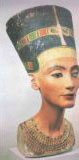 In an effort to make current social hopes supersede historical fact, Afrocentrists often point to the popular queen Nefertiti as a black-Egyptian queen. For starters, the bust of Nefertiti, from the Egyptian Museum in Berlin, is painted limestone – with the paint still very much visible. Though called Nefertiti, queen to Akhenaten, historians are not positive that this is who the bust actually represents. It was found in a sculptor’s workshop near the royal palace in the abandoned city of Akhetaten. Her skin is light tan in color. This image has lately become a favorite of black youth. Black artists who reproduce it give it distinct black-African features not found on the original; wide lips and a broad, flat nose characteristic of some Black-African females, but certainly not the Egyptian queen from North Africa. This is also a popular figure on shirts with the motto “Before there was history, there was black history,” and, with a rich chocolate skin color added, “Nefertiti, Nubian princess.” With all due respect, Nefertiti did not look like Aunt Jemima in a crown. Amazingly, some black Americans wear these hopeful icons, content to bask in the illusion that they depict reality, when minimal research in a local library would provide a color reproduction of this famous and often reproduced face. It is extremely sad that, discontent with their own history, some black Americans have taken to invention and patent absurdity in their efforts to achieve distinction in their ancestry.
Another example is Nefertiti’s nephew, the famous king Tut, occasionally touted as a black-African. A colored bust from his tomb, one of the early Tut, still retains its natural colors: a reddish hue for Tut’s skin tone. Tut was not a black-African. To the contrary, he probably would have been insulted to be called such since the Nubians were his traditional enemies. The young king wore their images on the bottom of his sandals so that he might symbolically trample upon them wherever he went (to show someone the bottom of your shoe is still a great insult in parts of the East.) (See Fig. 4) Tut’s color, as represented in Egyptian art, ranges from Gold (his death mask) to brown (wooden carvings of him) to stark white (his image rendered in the alabaster of his canopic jars). The various colors are reflections of the material used, not the actual skin color of King Tut.
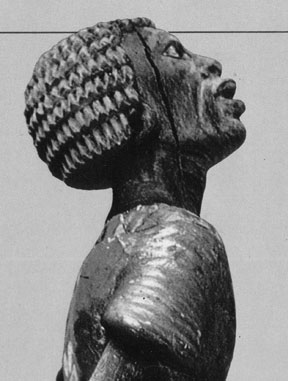
Fig. 2 . Head of a Negro, carved from ebony, from a throwing stick found in King Tut’s tomb.
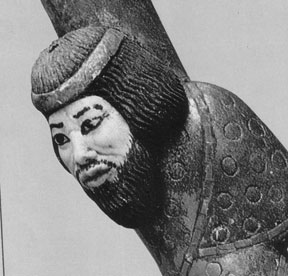
Fig. 3 Semitic head, carved from ivory, from the same throwing stick
Prodigious and exacting artists, when the Egyptians desired to evoke the dominant racial characteristics of the people around them, they did so with absolute fidelity. Semites are clearly recognized, as the figure on a carved throwing stick from Tut’s tomb demonstrates, as are Negroes, found on the same stick. (Fig. 2 and 3). As with art in modern propaganda, the Egyptians could be cruel in their bestowal of racial imagery, as is here seen in one of a pair of images of black-Africans found on King Tut’s sandals. (Fig. 4 )
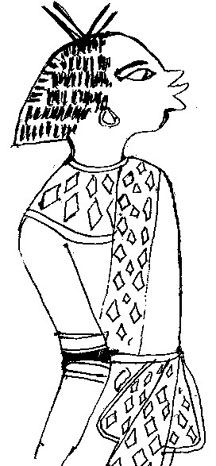
Fig. 4, Sandal image
They had images of their traditional enemies, the Nubians, carved on their footstools as well as depicted on their sandals, so that they could, symbolically, trample on them daily. The caricatured version of a Nubian on the young Pharaoh’s sandal shows that exaggerating racial characteristics for purposes of propaganda was as common in the ancient world as it in recent history.
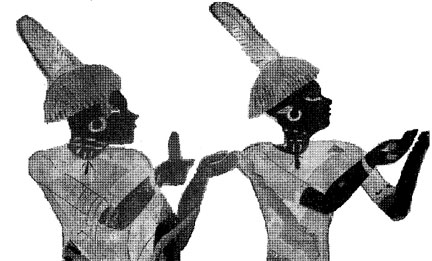
Egyptian depection of a Nubian
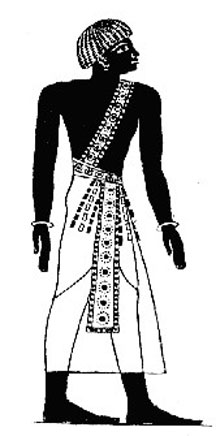
Egyptian depiction of a Sudanese
Egyptian coloration in portraits was no less realistic than other artistic features. One only has to look at them to know what the ancient Egyptians looked like: they looked like modern Egyptians. A prime example is the beautifully executed and still brilliantly colored statues of Prince Rahotep, son of King Snofru, and his wife Princess Nofret. Entombed for 5600 years, the statutes still provide accurate coloration, as do others, showing the women as fair skinned and the men, from longer exposure to the sun, as darker. (see figures 9 & 10)
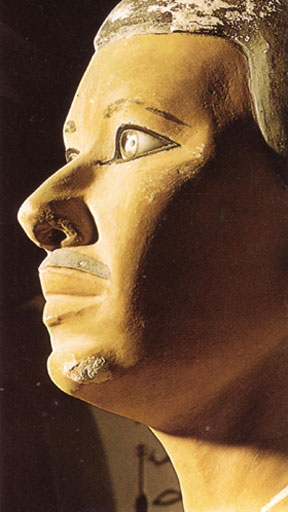
Figure 9: Rahotep. High priest. He has “copper-toned” skin. This is how an Egyptian looked circa 4700 B. C.
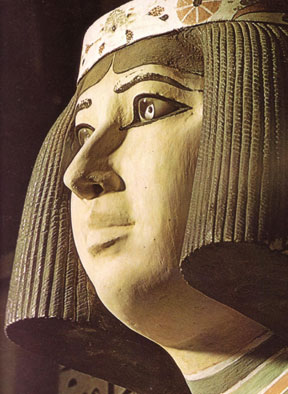
Fig. 10: Nofret
The hair on both is straight. The inlaid eyes of the statutes are strikingly realistic, made of rock crystal with amethyst irises, most are surprisingly blue-grey, not brown. Symbolic use of color, such as in the illustration of gods, is another story. The reference to Egypt as the ‘black land’ (KMT) or ‘black country’ was an allusion to the rich black soil of the Nile, which fecundated the ancient empire and was always distinguished from the ‘red land’ of the barbarians. Osiris, the principle god of ancient Egypt, was occasionally shown with tan skin, black skin, white, and green; none of these colors indicate that this religious symbol was a Caucasian, Negro, dove, or a frog.

Fig. 5: God Bes, representing the sun in old age
Another of the Egyptian gods was the solar deity Bes, representing the sun in old age and shown as an African pygmy. (fig. 5) Some have inferred a special significance about race because of this. “If a black was in their pantheon, they must be black.” Because some blacks, Anglos and Latinos worship a semitic god called Jesus, doesn’t make them ancient Jews! In and of itself Bes’s race makes no case for the Egyptians being black; gods of various hues are worshiped worldwide by people with no connection, cultural or social, much less racial, with the originators of the religion. There are Caucasians who are Hindu or voodoo practitioners, black Catholic bishops, and so on; this is true multiculturalism. However, Afrocentrists, wanting everything significant in life to reflect a black perspective, rankle at the thought of blacks worshiping Jesus, a deity who incarnated as a Jew. To that end they have played as fast and loose with religion as they have with history. The only evidence they cite as confirming an African pedigree for Jesus is a passage in Revelation in which John has a vision of Jesus and refers to brass colored feet and wooley hair; brass is brownish, most blacks have what could be described as wooley hair, i.e., in spite of all the lack of evidence elsewhere, Jesus is said to be black. Again, they play woefully with the truth, even truth that was intended as symbolic, such as John’s vision of Jesus in Revelation.
It defies most human reason, at least the reasoning ability of those with a semblance of knowledge about the ancient Jews, to contend that a black-African somehow came to be in a Hebrew family two-thousand years ago, went among the Hebrew people teaching apparently iconoclastic interpretations of their scriptures, scriptures interwoven with their body politic and daily existence, and yet somehow everyone – including the writers of the Synoptic Gospels, St. John, the Epistles, and so on – failed to mention the singular physical uniqueness of his person! Extraordinary, to say the least. Furthermore, the passages in Revelation do not actually lend themselves to the interpretation so prized by Afrocentrists. The first passage is from Revelation 1:14 and is a simile referring to his hair as “White like wool, as white as snow.” (Emphasis added) The simile relates to the whiteness of his hair, not the curliness of the wool. The second, from Revelation 1:15, refers to his feet as “like unto fine brass, as if they burned in a furnace;” (Emphasis added) The simile here is the glow of brass, not the color. Afrocentrists make nothing of his voice, which was “as the sound of many waters.” Clearly, a modicum of intelligent reading demonstrates that this is a symbolic description.The Egyptians were racist. That is, by the classical definition of the word, they thought themselves blessed by their birth to be special above all other people and that other races and cultures should be subservient to them. Like most civilizations that have walked the face of planet earth, they believed themselves to be superior to others in all respects. This superiority extended to the color of their skin. As the stelae of Kuban states: “the Syrians were light brown, the Libyans white, the Negroes black, but the Egyptians received from the gods their beautiful color, a deep dark brown for the men, a light yellow for the women.” They also used their language to express their superiority over all other races, including ‘Negroes, Asiatics and Libyans,’ by reserving for themselves the term ‘reth’, which is men in Egyptian. Other terms were reserved for the Asiatic and Negro races, with specific terms sometimes applying to locality or sex.
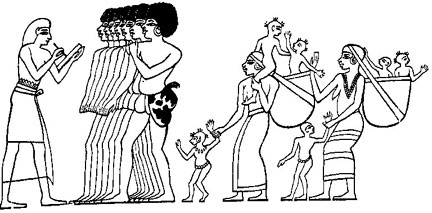
Fig. 8 Egyptian census taker with Nubian families. Old Kingdom. Notice the difference of the Egyptian census taker from the Nubians.
One way to clearly understand the Egyptian perspective on the black African is the obvious contrast of the two races when shown together, as in an illustration from Thebes depicting an Egyptian census taker with black Africans. (Fig.8) Note the detailed profiles, the noses, hair, lips, and even the rounded buttocks of the black-Africans, all racial features rendered with characteristic exactitude by the Egyptian artist. Such pictures refute the confused meanderings of a thousand Diops, Asantes, or Hilligards.

Fig. 6 From 30 BC. A silver coin bearing the image of Cleopatra VII. Note the consistency between figures 6 & 7
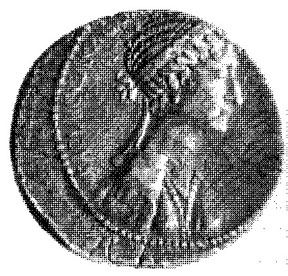
Fig. 7 A coin from Asia Minor (circa 32 B.C.) with the image of Cleopatra.
Another frequent target of ‘historical revisionists’ is the famous Cleopatra. (Actually, Cleopatra the Seventh, circa 68 B.C.) This lady, much maligned as a harlot and seductress, was in actuality a politically astute leader, intellectual and polyglot, speaking more than ten languages and the first of the Ptolemaic line, so it is said, who bothered to learn the native tongue of the Egyptians she ruled over. Cleopatra was not a native Egyptian, much less a black-African queen. She was the product of almost three-hundred years of Greek-Macedonian breeding on Egyptian soil; icons and coins containing her images show a long-necked Grecian face, with typical characteristics of the race which are preserved on other artifacts from her time. (Fig. 6 & 7)
One may of course assume that Macedonian Greeks who lived over two-thousand years ago had the foresight to know that they could occlude ‘black history’ by minting coins bearing the image of a ‘white Cleopatra.’ One may only marvel at their racist foresight; as well, we may that suppose that Cleopatra wouldn’t have allowed the coins to have been minted and distributed if they didn’t accurately represent her.
Though Egypt was certainly somewhat of a pluralistic society there can be no question that – with minor exceptions which will be delved into later – the Pharaohs were cut from Mediterranean cloth. This gets back to the evidence and ‘racist foresight’: Where are the mummies of the black Pharaohs? Did previous societies dig them up and replace them with non-black-African bodies? The earliest mummies we have are clearly not black-Africans. In exception to this, some have postulated that the higher melanin content in the skins of these early Egyptian mummies is evidence of ‘blackness’. Certainly, Blacks have higher melanin levels than the average European, but this is only proof of increased chemical levels, not racial pedigree; factors such as geographic location and time spent outdoors can affect the melanin content in the skin.
Black Pharaohs
Where there ever black pharaohs? Indeed. The relationship Egypt had with its nearest black African neighbors, the Nubians (Nubia, Ethiopia or Kush are often used interchangeably to denote the country which started just below the first cataract of the Nile), was extensive, mutable, and well documented. Nubia is frequently hailed by Afrocentrists as an original civilization and the one upon which Egypt was modeled on, in spite of the fact that Egyptian civilization is vastly older and superior in every way. Nubian civilization, when it developed into its highest form, was clearly a reflection of Egyptian culture, as can be traced through art and artifacts of both cultures. Nubia would be practically unknown historically if not given life through Egyptian writings. Nubia had no writing of its own before Egypt. The lack of written language in sub-Saharan Africa has presented a roadblock to the establishment of definitive arts and sciences, as well as a historical record of its own. The Nubians readily adopted Egyptian writing, but it is primarily excavations and the writings of other ancient cultures that gives us the scant information we have about them. The last culture of Nubia, the Meroe culture (270 B.C. to 350 A.D.), lost contact with the Egyptians. As a result they lost the ability to use and understand Egyptian hieroglyphics. They developed their own written language by 170 B.C., a quasi-cursive script called Meroitic, which so far remains undecipherable.
The first mention of Kush was in the reign of Usertsen I. (This regent is also called Sesostris) It was called ‘miserable Kush’ and was the southern part of Nubia. During the 12th dynasty his grandson, Usertsen III (Sesostris III), extended the borders of Egypt further south than ever before. In the eighth year of his reign a frontier stone was set up at the border of the two countries stating: “so that no Negro might pass it, neither by water nor by land, neither with boats nor with herds of the Negro.” Ambassadors or those traveling to market of Eqen were excepted. Later, as Egyptian desire for Nubian gold increased, Nubians were more readily accepted.
The relationship between Egypt and Nubia is long and involved. As early as the Old Kingdom the two countries were involved in warfare. Around 2600 B.C. the Egyptian annals record a great victory against the Ta-Seti, the Egyptian name for Nubia, by Sneferu (also written as Snofru), father of Cheops. The Egyptian monarch’s campaign reportedly netted 7000 prisoners and 20,000 head of captured cattle. But other things were prized more than cattle and slaves. For generations the pharaohs prized the products from Nubia, ivory, exotic animals, woods, pink and black granite, and gold – particularly the gold, which abounded in the southern land; in fact, the name Nubia comes from the Egyptian word ‘nub’ which means gold. By the Middle Kingdom (2040 to 1640 B.C.) a garrison had been built near the first cataract to mine gold and repel Nubians. According to Egyptian written records the Nubians were a dark brown people and were classed with ‘the southern barbarians’ as Nebes, or Negroes. Excavations from as early as the 6th dynasty show the Nubian governor as dark brown, though his court seemed to have been comprised of Egyptians.
The first cataract of the Nile formed a natural political division between Egypt and Nubia. The Nubians did not disdain closer ties with Egypt and naturalized themselves as officials and vassals of the pharaohs. As early as the 12th dynasty the northern part of Nubia was open to Egyptian civilization. The history of the two countries was an on-again off-again sort or thing, with frequent forays by the Egyptians in what can only best be described as looting expeditions into Nubia. Under a succession of 12th dynasty pharaohs Egypt penetrated into Nubia, bringing Egyptian civilization with them. Though Nubia had civilization prior to Egyptian influence, it had nothing comparable to Egypt until after 1550 B.C., when Egypt invaded, conquered, and ruled the southern society for 350 years, making its presence felt in art, architecture, and religion. The ruling classes of Nubia became thoroughly Egyptian.
Between approximately 1000 B.C. and 850 B.C. there is a great gap in the history of Nubia; however, around 750 B.C. they emerged from the shell of history as a strong nation and a rival to the fragmented Egyptian society.
For 500 years Nubia was ruled by viceroys under the title of “Royal son of Ethiopia.” As Nubia had no high civilization of its own at this time, Egypt’s dominance over it is not surprising. The earliest illustrations of the Nubians, from the time of Thothmes III, show them dressed in animal skins. As representations of them stretch out over the next few dynasties they are accordingly dressed in more progressive attire, showing a change in status and reflecting continuing Egyptian influence. By the New Kingdom their attire is indistinguishable from the Egyptians; only the presence of their racial features differentiate them. A color illustration from the Theban Dynasty which shows the reception of a Nubian prince demonstrates the care Egyptian artists used when depicting racial and cultural characteristics; the Nubians are shown wearing essentially Egyptian dress, with different hair styles, ox pulling their chariot instead of horses, and racial characteristics of black-Africans. The Egyptian artists were careful to differentiate Nubian skin tone, one Nubian having black skin, the other a light brown.
That which was said of Solomon and the ruling Israelite patriarchs who were considered apostate could also be said of the pharaohs of ancient Egypt; their importation of foreign wives brought the contagion, according to those who considered themselves purist in their religion and culture, of foreign fashions, including foreign gods. So many women of Asiatic and other bloodlines were imported into Egyptian royal harems that, as J.E. Manchip White noted, by the time of the reign of the son of Mutemuya, ” . . . the blood which flowed in the veins of the Egyptian royal family was almost entirely alien.”
Egyptian history was always more concerned with laudatory inscriptions for the current pharaoh than anything else; therefore, in regards to the whys and wherefores of the fall of dynasties, it exhibits a sparsity of detail that often leaves the modern historian grappling with near meaningless lists of the succession order of faceless characters. One thing is certain: like later Rome, the heavy dependency upon mercenaries contributed to the eventual downfall of the original social order and their replacement in government.
Such was the case with the Libyans, whom the Egyptians referred to as a ‘white’ race. Originally used as mercenaries by Ramses II (1298-1232 B.C.), the Libyan soldiers eventually managed, through astute political maneuvering and intermarriage, to weave themselves into the fabric of Egyptian power; in effect, they formed a government within a government. Near the end of the New Kingdom, around 1080 B.C., Egypt was involved in severe civil conflict, resulting in the fragmentation of the society into city states; it was then that Nubia became autonomous. By the time of Pharaoh Sheshonk’s reign (circa 930 B.C.) the Libyans were in power. This resulted in a conflict with the ruling priesthood–always the power behind the throne – who migrated in large numbers to the land of Kush, or Ethiopia, where Egyptian influence had been exerted since the twelfth dynasty, there to establish a microcosmic version of the civilization of their fathers. Thus was Egypt brought to Kush. For two hundred years there existed an unusual situation; Egypt was ruled by Libyans while to the south Nubia flourished as a mirror image east jump.
In approximately 700 B.C. Egypt was fragmented into feudal-like states (called Nomes), with various kings ruling different sections of the realm. To overcome this, the Lord of Sais, prince Tefnakht, began making moves to take over the other divided aspects with a view to getting all of Egypt under his control. After successfully arming the Western delta and capturing the major installations of the Eastern Delta, he began a campaign to overtake Upper Egypt. It was then that the king of Nubia, Piankhi, (the founder of the (2)th, or Ethiopian dynasty), perhaps fearing a consolidation of power by the Lord of Sais, stepped into the fray. By this time Nubia was in all of his mannerisms, social, political and religious, Egyptian. King Piankhi considered himself the successor to the Theban monarchy and was desirous of restoring ancient Egyptian cultural traditions, which were preserved in Nubia. Nubia had Egyptian style temples, clothes, hieroglyphic inscriptions, spoke Egyptian and worshipped the Egyptian pantheon.
The religious Piankhi even postponed his campaign to free Egypt to celebrate the New Year, the most important religious celebration of the Egyptians. Through judicious military tactics he made a waterborne attack while his army besieged by land at Memphis; the entrenched forces at Memphis were quickly overcome. After this the nomarchs surrendered. The Ethiopian king treated them with honor. The most amazing thing about the brief war was Piankhi’s action after his victory: In a move which has baffled historians, he proceeded to give the country back to its rightful regent; the Libyan King Osorkon, the last regent of the 23rd dynasty, reoccupied Thebes.
However, the peace didn’t last. Piankhi’s son Shabaka (716–701 B.C.) allowed Nubia to re-invade Egypt. His forces captured Bocchoris, son of Tefnakht of the 24th dynasty, and burned him alive. Thereafter, Shabaka occupied Thebes, the capital of Egypt, and reigned for fifteen years. He was succeeded by his son Shabataka. Numerous military alignments existed between the (2)th dynasty, the Nubian, and the Palestinians against King Ashur of Assyria. Eventually, around 690 B.C., Shabataka was murdered by his brother, the prince Taharka (690-664 B.C.) who then gained the throne. This was nothing unusual; political assassination was a common method of gaining political power and was pervasive in all ancient cultures. The younger prince, now king, in order to be a more effective ruler than his dynastic predecessors, set up a military dictatorship. In 671 B.C. the Nubian reign crashed under an assault on the city of Memphis by the Assyrian king Esarhaddon, cutting off Taharka’s lines of communication and supply. Taharka fled to Nubia and the Assyrian king left a garrison to rule. When, however, the Assyrian king left to return home, Taharka came back and recaptured Memphis – causing the Assyrian king to return immediately to Egypt; but, alas, he died en route.
In 666 B.C. the Assyrians, under new leadership, attacked Egypt again. At last, in 664 B.C. the Nubians fell to the third Assyrian invasion, they then abandoned all claims to Egypt and retreated behind their former borders. All in all, the Nubians ruled Egypt for sixty-years.
Conclusion: Nubia was a vassal state of Egypt; Egyptian ideals, government, and so on, were imported there. The reign of the Nubian dynasty in Egypt was, as with the Libyan and the later Persian and Greek dynasties, an intrusive one. The whole of the Nubian dynasty took place in the Late Period of Egypt and lasted less than a hundred years. The Nubian dynasty was not comprised of people indigenous to Egypt nor were they founders of ancient Egyptian dynasties.
SUMMATION
Under some systems of Afrocentrism black kids are being taught that whites not only enslaved their ancestors, but have historically taken their achievements away and erased their history. To accept such paranoid ranting we must assume a conspiracy of millennial proportions, with complicity by whites who had the foresight to know that it would matter to ‘racist Eurocentric Americans’ several thousand years down the road. The Afrocentric view is, as historian Authur Schlesinger Jr. says in regards to the Afrocentric theories espoused by Molefi Kete Asante, “. . . essentially, . . . Africa is the source of all good and Europe the source of all evil.”
For his part, Asante maintains that Afrocentrism is harmless and devoid of racism. There are differences between the races, but these don’t equate with hostility. He says: “One may be alien and yet not hostile. We only have to witness “E.T.” to see the truth of that proposition.” (E.T. – The Extra-Terrestrial (Widescreen Edition) ) Steven Spielburg’s movies are nice entertainment, but perhaps Asante could have found an example a little closer to reality to illustrate his point? Then again, maybe it is only too appropriate that an Afrocentrist use E.T. as an illustration of ‘truth.’
There is no doubt that the main push for multiculturalism is from black-Americans, in the form of Afrocentrism. To some intellectuals the close identification of American blacks with Africa is as absurd as it is pretentious. Arthur Schlesinger points out that some black families in America go back eight to ten generations. Yet, due to Afrocentrism’s lure, some are now calling for the teaching of black English in schools; a dialect version of English would only increase separation of blacks from the mainstream–where the money and jobs are. After three-hundred years on American soil, Schlesinger contends, the idea that black Americans have a legitimate cultural connection with Africa is unsustainable. Whether some like it or not, black-Americans are as uniquely American as whites. The Afrocentric movement, Schlesinger says, seems designed expressly to re-create American apartheid.
In spite of the wishes of would-be-Africans in America, the American connection to Africa is purely mythic in nature. Historian Schlesinger points out that there simply is not, and never has been a unified concept of philosophy, religion and politics over the vast and varied expanse of Africa. Africa, unlike Japan and other insulated societies, is not a homogenous entity. The idea that black skin gives one a mystical affinity with others with black skin is both artificial and dismaying. In its worst forms, Schlesinger warns, Afrocentrism is “profoundly racist.”(2)
Black-American children should be taught the truth: that no people hold a monopoly on racism; that white people enslaved black-Africans with the complicity of other black-Africans; that people of all ethnic and racial types have been enslaved throughout history; that blacks have enslaved blacks and whites have enslaved whites; and that white Americans shed their own blood in a war to free American blacks from slavery. Whites even today greatly outnumber blacks in America; if the majority of whites didn’t want freedom and equality for blacks, the civil war would have never happened – much less the civil rights movement. The United States Constitution may stumble now and then, but it eventually rights itself and walks upright. In education, where minds are molded for the future, trends such as Multiculturalism and Afrocentrism are only the latest attempt to address the abysmal scores of black students on standardized tests. Current attempts to address this problem – which seem to include everything except the students working harder – range from the practical to the ridiculous. The only irrefutable truth is that a student who knows he or she can do the work, doesn’t need the false self-esteem provided by Afrocentrism. 23
All direct quotes, statistics, and historical data not otherwise attributed are taken from the following sources:
“Mr. Sobol’s Planet,” The New Republic, July 15 & 22, 1991.
Alex Boyd & Catherine J. Lenix-Hooker, “Afrocentrism: Hype or History?,” Library Journal, November 1, 1992.
Andrew Sullivan, “Racism 101,” The New Republic, November 26, 1990.
Boyce Rensberger, “Black Kings of America,” Science Digest, September 1981.
Fred Siegel, “The Cult of Multiculturalism,” The New Republic, February 15, 1991.
Nicholas Davidson, “Was Socrates a Plagiarist?,” National Review, February (2), 1991.
Gerald Early, “Their Malcolm, My Problem,” Harper’s Magazine, December 1992.
Henry Louis Gates Jr., “Beware of the New Pharaohs,” Newsweek, Sept. 23, 1991.
I.E.S. Edwards, Tutankhamun: His Tomb and Its Treasures, The Metropolitan Museum of Art and Alfred A. Knopf, Inc., 1976.
Christine Hobson, World of the Pharaohs, Thames and Hudson, 1987.
Adolf Erman, Life in Ancient Egypt, Dover Publications Inc. 1971.
E.A. Wallis Budge, An Egyptian Hieroglyphic Dictionary, Vol. I and II, Dover Publications, Inc., 1978.
David Roberts, “Out of Africa: the superb artwork of ancient Nubia,” Smithsonian, June 1993.
J.E. Manchip White, Ancient Egypt, Dover Publications Inc., 1970.
Molefi Kete Asante, “Putting Africa at the Center,” Newsweek, September 23, 1991.
“Haley Blasts Debate Over Methods Of Teaching Black History In U.S. Schools,” Jet Magazine.
Mary Lefkowitz, “Not Out of Africa,” The New Republic, February 10, 1992.
Barbara Kantrowitz, Pat Wingert, Patrick Rogers, Nadine Joseph and Shawn D. Lewis, “A Is for Ashanti, B Is for Black…,” Newsweek, September 23, 1991.
Sharon Begley, Farai Chideya and Larry Wilson, “Out of Egypt, Greece,” Newsweek, September 23, 1991.
“Inner-city schools find harder classes really get results,” Atlanta Constitution, 12/12/93.
Dalia Baligh, “African explorers beat Columbus to Americas by hundreds of years?” Atlanta Constitution, 2\12\93.
John Taylor, “Are You Politically Correct?,” New York, January 21, 1991.
Fredric Smoler, “What Should We Teach Our Children About American History?,” Interview with Arthur Schlesinger, Jr., American Heritage Magazine, 1992.
Ralph Waldo Emerson, “An address in the court-house in Concord, Massachusetts, on 1st August, 1844, on the anniversary of the Emancipation of the Negroes in the British West Indies, 1844.” Cited in Illiberal Education, Dinesh D’Suza.
David Brion Davis, The Problem of Slavery in Western Culture, Oxford University Press, New York, 1966.
Robert Hughes, Culture of Complaint, Oxford University Press, 1993.
Charles Krauthammer, “Education: Doing Bad and Feeling Good,” Time February 5, 1990
Thomas Kochman, Black and White: Styles in conflict, University of Chicago. Cited in Illiberal Education, by Dinesh D’Souza.
Murray Gordon, Slavery in the Arab World, New Amsterdam Books, New York, 1989.
“Haley fabricated family history in “Roots,”” article claims,” Atlanta Constitution, 2/18/93 from the Village Voice.
Deborah Scroggins, “Africa on the brink,” Atlanta Constitution, 4/11/93.
Abnormal Psychology, CRM Books, 1972.
Update – Baldilocks takes on Rev. Wright’s view of Chrisitanity
Excuse my English (and pardon the pun) but who gives a DAMN about skin color, type of clothing and style of music when it comes to the realm of saving souls and keeping them out of Hell? Why, Wright and BLT’s “founder” James Cone do. As a matter of fact they worship these things instead of the Creator. Wright rightfully claims that Christian missionaries of Europe fell into error and sin back when they were bent on converting the natives of all lands. Not by the act and desire of leading others to Christ, but by making Christianity about something other than Him, His Sacrifice, Resurrection and the purpose thereof. The missionaries bound up Christ in themselves and their own culture. But Wright now is mired that same error while condemning the missionaries for it out of the other side of his mouth. Beams and motes indeed.
If you’d like to read more, City Journal has a piece by Heather MacDonald – “Poisonous Authenticity.”